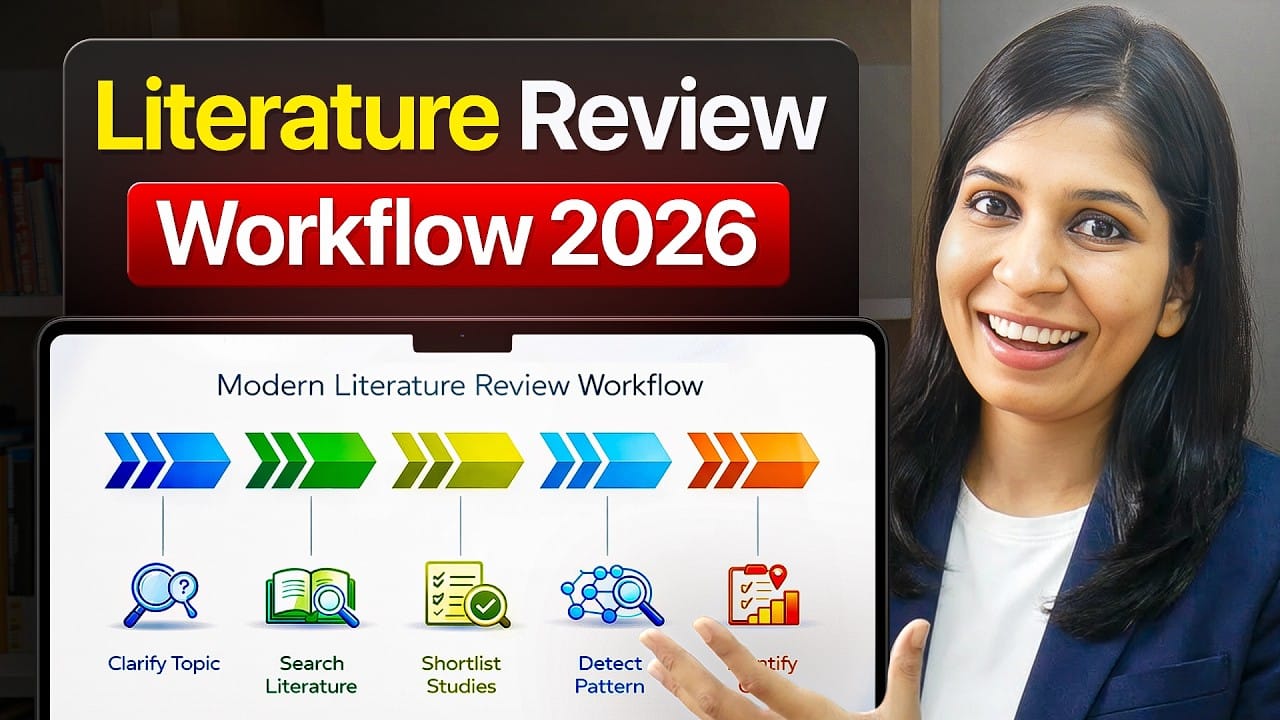
Literature review can take enormous amount of time: PhD scholars, Masters students and faculty need to undertake multiple tasks to make progress. They need to read through research papers, comprehend the terminology, make comparisons between studies and compile all the collected information in order to build their own research methodology.
Today, there are specialized AI tools for research which can help a researcher in all aspects of their research.
However, most research students are today unaware of these tools or how to use them effectively to avoid plagiarism. The latter is the most important problem. Students today are know the names of the tools but few are able to apply it effectively for their research.
AI upskilling is a major need being felt across the world. We spoke with the AI upskilling institute Gyansetu whose founder Sahil Aggarwal noticed a similar gap between students knowledge of AI tools and ability to be able to use AI to solve a problem.
Here are five ways PhD scholars, faculty conducting research and full time researchers can use AI for literature review.
1. Use AI to Identify the right research paper
The first hurdle in research is always discovery.
AI can assist you in transforming your broad topic into better search terms prior to searching academic sources.
You can ask it to generate:
- alternative keywords
- academic terminology
- related concepts
- possible variables
- different population terms
- methodological terminology
- competing perspectives
- narrower research questions
Try this research prompt
“I am studying the connection between social media and mental well-being in college students. I need 10 queries that I can use in my academic search to look for relevant papers. Classify them into general, specific and methodology searches. Do not create papers, authors or citations.”
That gives you a much stronger starting point.
As a first step, you can then take those terms into scholarly search systems such as Google Scholar. Google Scholar lets users search across scholarly literature including articles, theses, books, abstracts and other academic sources, and also provides related works and citation exploration.
You can also use leading literature review tools such as Consensus, Scispace, Answerthis who have built-in features to help you identify the right research papers.
However, it’s important to call out the right approach here.
“A student who uses AI to improve their search terms and check the literature is able to successfully publish their research in a leading journal while a student who requests AI to give five papers and simply copies the results is most likely to get rejected by journals.”
Learn how to use Claude for your literature review in the below video –
2. Use AI to Understand Difficult Research Papers
Finding a paper is one task but there’s another one which comes after finding it – comprehending it.
Papers may include concepts, methodologies, statistical analysis, literature review and limitations that may be difficult for a reader to understand at a glance.
AI can be a reading assistant.
Let’s imagine you’ve located a paper that can help you write your dissertation but you don’t understand the paper’s methodology.
Instead of asking:
“Summarise this paper.”
ask something more specific:
Describe the methodology section of the study in easy terms. State the research question, sample size, variables, method and limitation in the paper. Use only information provided in the paper.
You can then ask:
- What exactly did the researchers measure?
- Why did they choose this methodology?
- Who participated in the study?
- What does this statistical result mean?
- What are the limitations?
- Does this study establish correlation or causation?
- What conclusion can reasonably be drawn from the results?
This is a much better application of artificial intelligence.
It does not mean replacing the paper.
It means using the AI to interrogate the paper.
Learn how to Read a Research paper in 2 minutes using AI Tools in the below video
3. Use AI to Discover Related Research
One good academic paper alone could be used for finding other sources.
Instead of looking at each source separately, focus on examining the relationships between these sources.
The sources that could be found from one good academic paper include:
- earlier papers it cites
- newer papers that cite it
- related studies
- researchers working on the same problem
- foundational theories
- competing findings
- newer developments
Tools such as Consensus are based on the principle of such literature searching, thus letting researchers track their predecessors and successors.
This provides a much better way for conducting research:
Strong paper → earlier research → related research → newer research → competing findings → potential research gap
Learn how to find a research gap in 5 minutes using AI tools in the video below
4. Use AI to Compare and Synthesise Evidence
Reading ten papers does not necessarily constitute a literature review.
A literature review entails a process of synthesis.
Consider that you have identified five articles on the impact of social media on university students.
A poor literature review can be something like this:
In Study A, the finding was X.
In Study B, the finding was Y.
In Study C, the finding was Z.
A stronger review asks:
- Where do they agree?
- Where do they disagree?
- Was the methodology the same?
- Were the participants the same?
- Was the data collected the same?
- Are there limitations common to both?
- Why would their results be different?
Let AI help you make these comparisons.
Learn how to select a research topic for PhD or Master’s using AI tool in the below video
Try this prompt
Analysis of five research studies is presented here. Indicate where the authors concur and where they diverge. Compare their methodologies and indicate the possible limitations of those methodologies that occur across several studies. All findings must be attributed to their original sources.
You might then build a working evidence table:
| Research factor | Study A | Study B | Study C |
| Research focus | Social media use | Social media intensity | Online interaction |
| Sample | University students | Young adults | University students |
| Method | Survey | Longitudinal | Survey |
| Main finding | Association identified | Mixed result | Association identified |
| Limitation | Self-report | Small sample | Cross-sectional |
The table doesn’t give you the conclusion.
It gives you a better basis for thinking about the conclusion.
Research-focused AI tools can help here
The current processes of research that Elicit uses include research agents, research reports, and systematic-review processes. The documentation by Elicit explains uses that range from identifying papers to synthesizing evidence.
5. Use AI to Organise Research and Citations
There is a second issue that most students realize only later:
research gets messy.
You begin with five sources.
Then you add ten more.
Then another dozen.
Soon you have:
- PDFs with confusing filenames
- browser tabs everywhere
- notes in multiple documents
- screenshots
- copied quotations
- duplicate papers
- incomplete references
- AI summaries with unclear sources
Now, organisation becomes a component of good research.
Software for managing references like Zotero allows you to gather, organize, annotate, and cite your research material. Zotero also currently provides functions for organizing references into collections, tagging and generating bibliographies.
Learn the Top 5 Free AI tools for Literature Review
A Simple AI Research Workflow Students Can Follow
You don’t need 30 AI tools to conduct better research.
You need a workflow.
Step 1: Define the research question
Specify the problem you need to investigate.
Step 2: Expand your keywords
Use AI to find synonyms, related concepts and academic terminology.
Step 3: Find original research
Search academic databases and scholarly search engines.
Step 4: Select quality literature sources
Don’t try to read every result. Choose the literature which is more relevant to your question.
Step 5: Expand through the research network
Explore citations, authors, related papers and newer studies.
Step 6: Use AI as a reading assistant
Ask focused questions about terminology, methodology, results and limitations.
Step 7: Compare the evidence
Identify areas of convergence and divergence, different methodologies used.
Step 8: Organise your references
Use a reference manager and keep notes connected to their sources.
Step 9: Develop your own argument
Your research question, interpretation and argument should remain yours.
Step 10: Check your work before submission
Verify the validity of any facts claimed against the actual research findings.
You can join WiseUp’s certificate course Master AI Tools for Research to identify the right research AI tool across your research tasks and learn how to use the tool ethically without plagiarism and AI detection.
What Should Students Not Ask AI to Do?
The easiest way to misuse AI in research is to give it responsibility that belongs to you.
Be careful about asking AI to:
- invent research papers
- create citations without verification
- fabricate quotations
- make up statistics
- claim that a study says something it doesn’t
- replace required reading
- produce an argument you haven’t evaluated
- conceal prohibited AI use
- generate evidence you haven’t checked
Instead, use AI to:
- explore
- question
- compare
- organise
- explain
- generate search directions
- identify relationships worth investigating.
Five AI Research Tasks at a Glance
| Research problem | How AI can help | What the student must still do |
| Finding literature | Expand keywords and search queries | Search and verify original papers |
| Understanding papers | Explain terminology and methodology | Read the source and assess limitations |
| Discovering related research | Identify concepts and research connections | Investigate the actual literature |
| Comparing evidence | Organise similarities and differences | Judge the strength of the evidence |
| Managing research | Structure notes and source relationships | Maintain accurate citations and attribution |
Each AI assignment is accompanied by human research.
It is this that makes the process academically valuable.
Final Takeaway
Students can use AI tools for research in five particularly useful ways:
- Find better sources and search terms.
- Understand difficult academic papers.
- Discover related and influential research.
- Compare and synthesise evidence.
- Organise research notes and citations.
The most effective outcomes can be achieved if AI is viewed as an assistance in the research process and not as its authority.
This is the reason why real implementation is more important than gathering a list of all AI tools that can be found.
If a student has a clear idea about why and when to use Google Scholar, why and how to interact with citation networks using ResearchRabbit, why and how to apply evidence-based workflow like Consensus, where and why reference manager like Zotero can be applied, above all – how to validate evidence that is collected, this means that he or she has acquired much more valuable skills than knowledge about 20 AI tools.
As per our conversation with the founder of another AI upskilling institute Gyansetu whose founder Sahil Aggarwal spoke to us about how he saw the best results when his students developed a step-by-step AI workflow for their projects.
As far as research is concerned, the answer is obvious:
Do not gather AI tools. Create an AI-enabled research workflow.
You can join WiseUp’s certificate course Master AI Tools for Research to identify the right research AI tool across your research tasks and learn how to use the AI tools ethically without plagiarism and AI detection.
Founder, WiseUp Communications